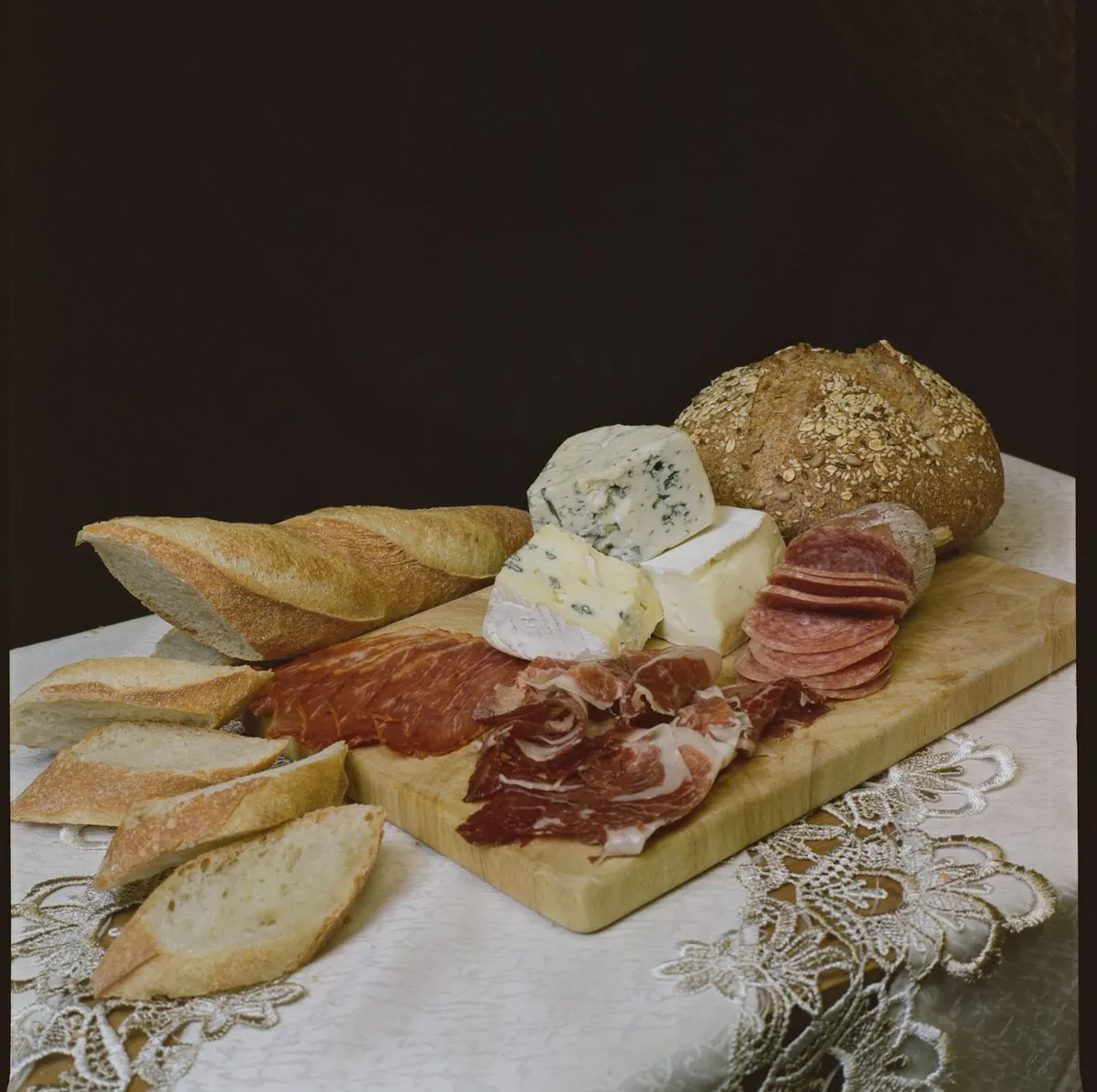
Picture a singer leaving Toulouse before dawn with a vielle on one shoulder and a linen satchel on the other. The romance of the road is easy to imagine; the menu is harder. No medieval account book lists “troubadour rations,” and no single road diet stretched from Catalonia to Lombardy. What we can reconstruct is a set of sensible habits: carry food that survives jolting, heat, and damp; eat hot food when a tavern or kitchen offers it; and treat hospitality as both nourishment and payment. A troubadour on the road ate like any other careful traveler, only with a song ready when the table was cleared.
Before setting out, a traveler thought less about flavor than about spoilage. Fresh meat, soft cheese, ripe fruit, and new bread were liabilities on a muddy road. The reliable staples were dry and dense. Bread was often baked hard—rye, barley, or a coarse wheat mixture—and could be eaten stale, crumbled into pottage, or softened in wine. Hard cheese traveled better than soft; salted or smoked pork and bacon kept for weeks; dried peas and beans provided weight and substance; onions and garlic added flavor and kept reasonably well. Salt was worth carrying in a small cloth or horn box, not because it was rare, but because road food was bland.
A plausible satchel larder looked like this:
Not every traveler carried all of it. A singer moving between courts might rely on the next household for the next meal. But the principle held: choose food that improves with time or at least refuses to spoil quickly.
Most travel began early. At an inn, the first meal might be bread and cheese with ale or watered wine; at a monastery guesthouse, bread and ale; in a camp, whatever remained from the night before. A singer with a performance ahead did not necessarily eat heavily. A warm drink and a little bread were easier than a full stomach before singing. If there was a fire, a pottage could be warmed with onions and a little bacon; eggs were seasonal and local.
The practical rule was simple: eat the perishable first. Soft cheese, fresh fruit, and cooked food had to be finished before the hard bread and salted meat. That habit kept a traveler from wasting what could not be replaced and from carrying a smell that announced itself before the singer did.
By midday, the road had made everyone hungry. A tavern or village cookshop might offer pottage: peas, beans, or grain simmered with onions, herbs, and sometimes a little bacon. Bread mopped it up. Eggs, cheese, and greens rounded out the meal. In wine country, the drink was local and often watered; in ale country, ale was the ordinary drink. Water from a known well or spring was also drunk, though travelers were cautious about stagnant or suspicious sources.
At a castle or wealthy townhouse, the food could be much richer: white bread, roast meat, spiced sauces, and wine. A traveling singer might see such dishes only when a patron invited him to the high table. The invitation was the point. The meal was entertainment’s reward, and the singer’s place depended on courtesy, timing, and the lord’s mood.
Even at a good table, a traveler ate what was set before him. Refusing a dish could insult a host; asking for something else was worse. The practical troubadour praised the food, sang well, and did not linger too long.
Medieval hospitality was not charity in the modern sense. It was a system of obligations. A castle, abbey, or prosperous household that fed a traveler gained entertainment, news, and reputation. A singer who arrived with a good song and decent manners could expect bread, ale or wine, a place by the fire, and sometimes a bed in the hall or guesthouse. In return, he gave a performance, praised his host, and carried the host’s name to the next town.
Customs varied, but some rules held. Wash your hands before eating when water was offered. Use the knife you carried to cut food, and do not put it in your mouth. Share what you have; a gift of dried fruit or a small token was polite. Thank the cook or server, not only the lord. And leave before welcome turned into burden.
The church calendar shaped the menu. On fasting days—especially Lent—meat was off the table for many people, and fish, bread, vegetables, and pottage took its place. Rules varied by region, rank, and religious house, so a traveler followed the local custom. Dried fish and salted herring were useful where they could be obtained; inland, beans and peas did more of the work. Cheese and eggs were restricted in some places and allowed in others.
A troubadour who arrived during a fast did not complain about the lack of roast meat. He ate the bean pottage, praised it, and saved his appetite for Easter. Not every road was generous, either. Between courts, a singer might pass through country where the next meal was uncertain. Then the satchel mattered: a heel of bread, a piece of cheese, a handful of nuts. The romance of the road was often a matter of chewing slowly and hoping for better weather.
If you want to taste the practical side of troubadour travel, build a meal around what keeps. Take a dense loaf, a hard cheese, dried fruit, nuts, and—if you eat meat—a little salted or smoked pork. Add an onion or a few cloves of garlic, a small packet of salt, and a bottle of water. A knife, a cloth, and a wooden or leather cup are enough. Keep perishables cool, wash your hands before eating, and adapt the list to your diet and allergies.
Eat the fresh food first and the hard food last. When someone offers you a table, accept graciously, eat what is set before you, and offer something in return: a song, a story, a hand with the dishes. That exchange, more than any single dish, is what fed a troubadour on the road.
Photo: Alexey Chudin / Pexels

When the Albigensian Crusade broke the small courts of Languedoc, troubadours lost their audiences, their patrons...

A practical packing checklist for medieval music festivals, covering instruments, repair kits, layered clothing,...
Seven towns and ruins in southern France where troubadour history actually happened, from Ventadour's castle to...


Daily songs and stories from a troubadour.
